
The private detention industry is growing fast enough that investors need a reliable way to see where their portfolios touch it.
CoreCivic and GEO Group together reported roughly $1.4 billion in revenue for the April–June quarter, as US immigration detention approached record levels.
CoreCivic’s revenue alone rose just over 27 percent year over year, to $684.9 million. Separately, the company sold four facilities to the Department of Homeland Security for net proceeds of $1.6 billion — which President and CEO Patrick Swindle told investors works out to an average of about $307,000 per bed (NPR, August 8, 2026).
Exposure to this sector rarely shows up where an investor would expect to find it. To make it visible, As You Know provides the expanded and updated Prisons & Borders Company Dataset.
The work builds on a foundation laid by the American Friends Service Committee, which maintained the original dataset for years. As You Know has taken on ownership and stewardship of the data product, with research conducted by our partner organization As You Sow, which is actively expanding its coverage, depth, and update frequency.
How the Rating is Bult
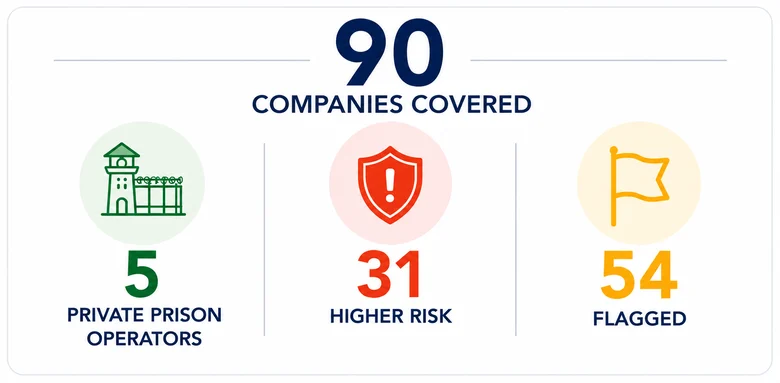
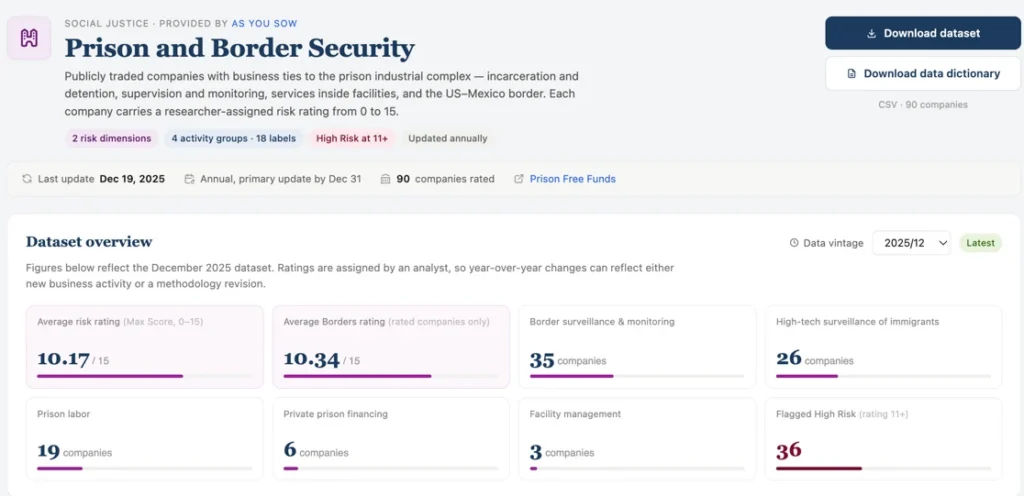
The dataset covers 90 publicly traded companies. An analyst scores each one on three factors, 0 to 5 apiece, for a rating between 0 and 15: salience (the severity and scale of the risk activity), responsibility (how intentionally the company is involved), and responsiveness (potential responsiveness to public and investor concern). Sources include government contract databases such as USASpending.gov, public reporting, and company releases.
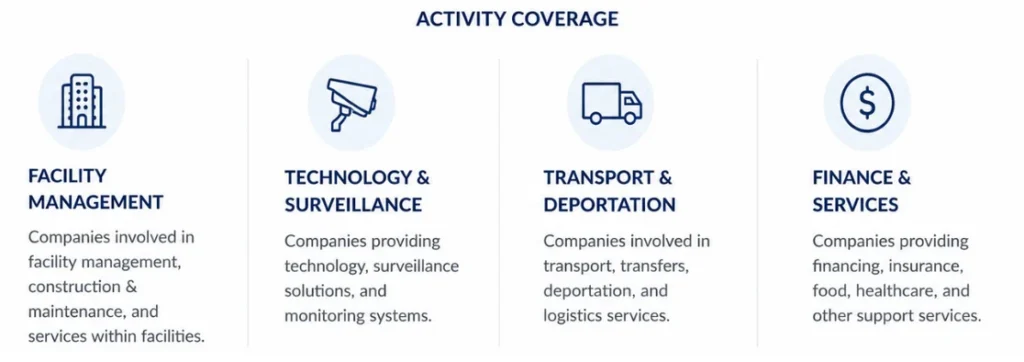
Companies can be rated on two dimensions — Prisons and Borders — and many are rated on only one. Where both apply, the higher of the two is the rating that counts. Beneath the scores sit 18 activity labels across four groups, covering facility management, construction and maintenance, services provided inside facilities, community corrections and electronic monitoring, prison labor, prison financing, border construction and surveillance, immigrant monitoring technology, transport and deportation, and more.
A rating of 11 or higher carries the High Risk label used in Prison Free Funds screening.
A Basis for Engagement
The rating is built to open conversations rather than close them. Responsiveness is one of the three scoring factors for exactly that reason: it asks a forward-looking question about whether a company is positioned to respond to investor concern.
A high rating identifies where a shareholder dialogue is worth having — on contract transparency, on labor practices inside facilities, on what data is shared with enforcement agencies — rather than settling the question of what a company is.
Ratings are analyst-assigned and reviewed annually, so a company’s score can move because its business activity changed or because the methodology did.
A company that exits a line of business, tightens a policy, or clarifies an ambiguous contractual relationship can see that reflected in the next vintage. The dataset is a record of what is currently known, held open to revision.
What Comes Next
Our research team continues to expand the Prisons & Borders Company Dataset, re-assessing rated companies and adding new names as business connections to the prisons and borders industries are confirmed.
Our data provider As You Sow is also scoping several new projects for the dataset. Stay tuned.
